
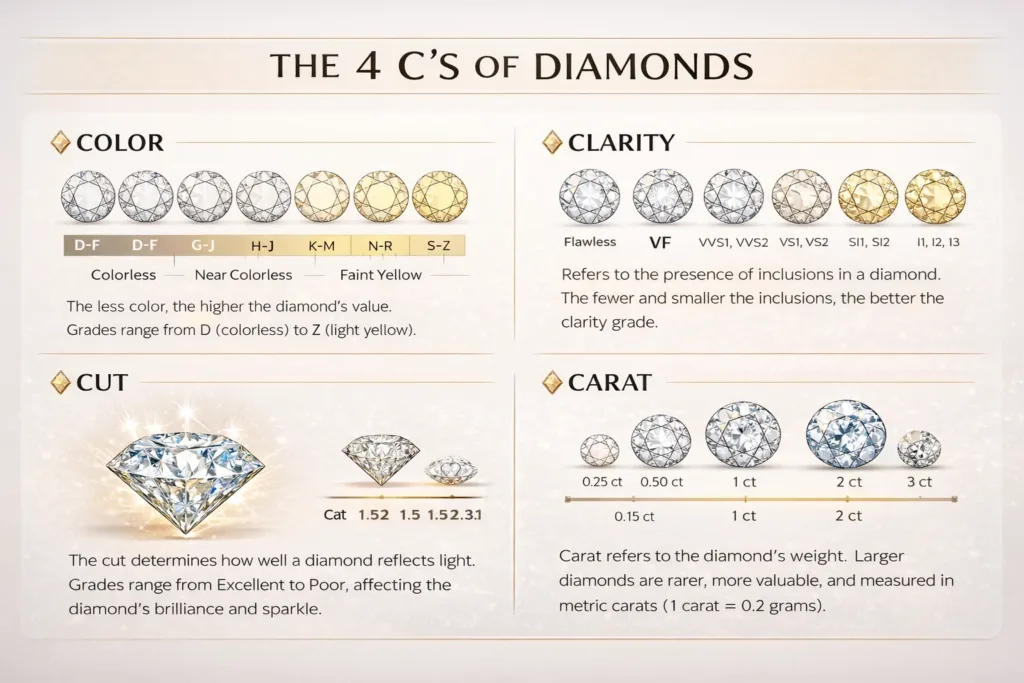
If you have started looking at diamond jewellery, you have probably come across the term 4Cs. But what is diamond 4cs actually referring to? The 4Cs are Cut, Colour, Clarity, and Carat Weight, four characteristics used to describe and evaluate a diamond.
If you are new to diamond buying, understanding what is diamond 4cs can make the grading terms much easier to follow. Instead of looking at a diamond certificate as a list of unfamiliar numbers and grades, you can understand what each part means and how it affects the stone.
The system was developed and popularised by the Gemological Institute of America (GIA) and has become a widely recognised way to communicate diamond quality. Understanding these four factors can make it easier to compare diamonds and decide which characteristics matter most to you.
What Are the 4Cs of a Diamond?
The 4Cs describe different aspects of a diamond rather than one single measure of quality. Each C tells you something different about the stone.
| 4C | What It Measures | Why It Matters |
|---|---|---|
| Cut | How the diamond is proportioned and finished | Affects sparkle and light performance |
| Colour | Degree of colour in the diamond | Influences how white or warm the diamond appears |
| Clarity | Internal and external characteristics | Helps describe how clean the diamond looks |
| Carat | Diamond weight | Affects size and usually has an impact on price |
When people ask what is diamond 4cs, this is the simplest way to remember it: Cut affects sparkle, Colour affects appearance, Clarity describes natural characteristics, and Carat measures weight.
1. Cut: How Much Does a Diamond Sparkle?
Understanding what is diamond 4cs also means knowing why cut is different from diamond shape. Cut describes how well the diamond interacts with light, while shape describes the visible outline of the stone.
A well-cut diamond can return more light to the viewer, creating brightness, fire and scintillation. This is why two diamonds with the same carat weight can look noticeably different.
Cut vs Shape
These terms are sometimes confused:
- Cut: The quality of the diamond’s proportions and craftsmanship.
- Shape: The outline or form of the diamond, such as round, oval, pear or emerald.
If you are choosing an engagement ring, understanding the difference can help when comparing different stones. Aary Jewellery also provides guidance on diamond shape for engagement ring styles and how different shapes can change the overall appearance of a ring.
2. Colour: How White Is the Diamond?
Diamond colour refers to the degree of colour present in a diamond. For the standard D-to-Z grading scale, diamonds closer to D are considered more colourless, while lower grades can show more noticeable yellow or brown tones.
This does not mean that a lower colour grade automatically looks bad. The right choice depends on the diamond, setting, metal colour and your personal preference.
This is another reason what is diamond 4cs is useful for beginners, as colour should be considered together with the setting and the overall look you want.
3. Clarity: What Does a Diamond’s Clarity Grade Mean?
Clarity describes the internal features called inclusions and external features called blemishes. These characteristics form naturally as diamonds develop under extreme conditions.
GIA’s clarity scale ranges from Flawless (FL) to Included (I3). Higher clarity grades generally have fewer visible characteristics, but the best choice is not always the highest grade available.
What matters is whether inclusions can actually be seen without magnification and how they affect the diamond’s appearance. For many buyers, a diamond that looks clean to the naked eye can provide a practical balance between appearance and budget.
4. Carat: Is a Bigger Diamond Better?
Carat weight measures how much a diamond weighs, not exactly how large it looks. One metric carat equals 200 milligrams, and each carat is divided into 100 points.
For example:
- 0.50 carat = 50 points
- 0.75 carat = 75 points
- 1.00 carat = 100 points
- 1.50 carats = 150 points
A larger carat weight can increase a diamond’s price, but carat alone does not determine beauty or quality. Two diamonds with the same carat weight can have different appearances and prices because their cut, colour and clarity can vary.
Source: Gemological Institute of America (GIA).
Once you understand what is diamond 4cs, it becomes easier to compare two diamonds without focusing only on their carat weight or price. The goal is to understand the balance between the four characteristics.
How Do the 4Cs Work Together?
The 4Cs should not be considered separately when comparing diamonds. A diamond with a higher grade in one category may not necessarily look better overall than another diamond with a different combination of grades.
For example, imagine two 1-carat diamonds:
- Diamond A has excellent cut, slightly lower colour and good clarity.
- Diamond B has higher colour and clarity but a weaker cut.
If sparkle is your main priority, Diamond A may have the visual characteristics you prefer. This is why looking at the complete diamond rather than focusing on one number is important.
Which of the 4Cs Should You Prioritise?
There is no single combination that works for everyone. Your priorities should depend on your budget, jewellery design and how you want the diamond to look.
Understanding what is diamond 4cs can help you decide which characteristics deserve more attention based on your budget and personal preferences.
A simple approach is:
- Start with your budget. Decide how much you are comfortable spending.
- Consider cut and visual appearance. Look at how the diamond performs under light.
- Choose a suitable colour range. Consider the metal used in the setting as well.
- Check clarity. Look at whether inclusions are visible and affect the appearance.
- Choose your preferred carat weight. Consider how the stone looks in proportion to the ring.
This approach is especially useful when looking at an engagement ring because the diamond needs to work with the setting, proportions and overall design.
Why the 4Cs Matter When Choosing an Engagement Ring
Understanding the 4Cs gives you a better starting point when browsing engagement rings. Instead of judging a diamond simply by size or price, you can understand what those numbers actually represent.
For anyone learning what is diamond 4cs before buying an engagement ring, these four factors provide a useful starting point for comparing different diamonds.
For couples in Singapore, there are also many different styles to consider, from classic solitaire rings to more detailed halo and modern designs. You can explore Aary Jewellery’s engagement ring collection to see how different diamond characteristics are used in finished jewellery.
The 4Cs are useful for comparing diamonds, but they should not replace looking at the actual stone. Lighting, setting and diamond shape can all influence how a finished ring appears.
A Simple Example: Choosing a 1-Carat Diamond
Consider someone looking for a 1-carat diamond engagement ring with a limited budget.
Instead of automatically choosing the diamond with the highest clarity grade, they could compare several stones with similar carat weights and focus on visible differences. If one diamond has a strong cut and looks clean to the naked eye while another has a higher clarity grade but weaker light performance, the first option may be more appealing based on personal preference.
This example shows why what is diamond 4cs is not simply a question about which grade is highest. The 4Cs are a framework for understanding the differences between diamonds.
Conclusion: Understand the 4Cs Before Choosing Your Diamond
Knowing what is diamond 4cs gives you a useful foundation before buying a diamond. Cut, Colour, Clarity and Carat each describe something different, and the best combination depends on your preferences, budget and the jewellery design you want.
Rather than focusing on one grade, look at how the 4Cs work together and how the finished diamond looks. For more guidance on diamonds and engagement jewellery, explore Aary Jewellery and discover pieces designed with diamond quality, craftsmanship and personal style in mind.
FAQs (Frequently Ask Questions)
What is diamond 4cs and why does it matter?
What is diamond 4cs refers to the four main characteristics used to describe diamond quality: Cut, Colour, Clarity and Carat Weight. Understanding these factors helps buyers compare diamonds more confidently.
Which C is most important in a diamond?
There is no single C that is most important for every buyer. Cut can have a strong effect on sparkle and light performance, while colour, clarity and carat influence other aspects of the diamond’s appearance and value.
Is carat the same as diamond size?
No. Carat measures the weight of a diamond, not its exact visible size. The diamond’s shape, proportions and cut can affect how large it appears.
What is the difference between diamond cut and diamond shape?
Diamond cut refers to the quality of its proportions and craftsmanship, while shape describes its outline, such as round, oval, pear or emerald.
Do I need a high clarity grade for an engagement ring?
Not necessarily. A higher clarity grade can mean fewer inclusions, but a lower grade diamond may still appear clean to the naked eye. Comparing the actual diamond is important.